
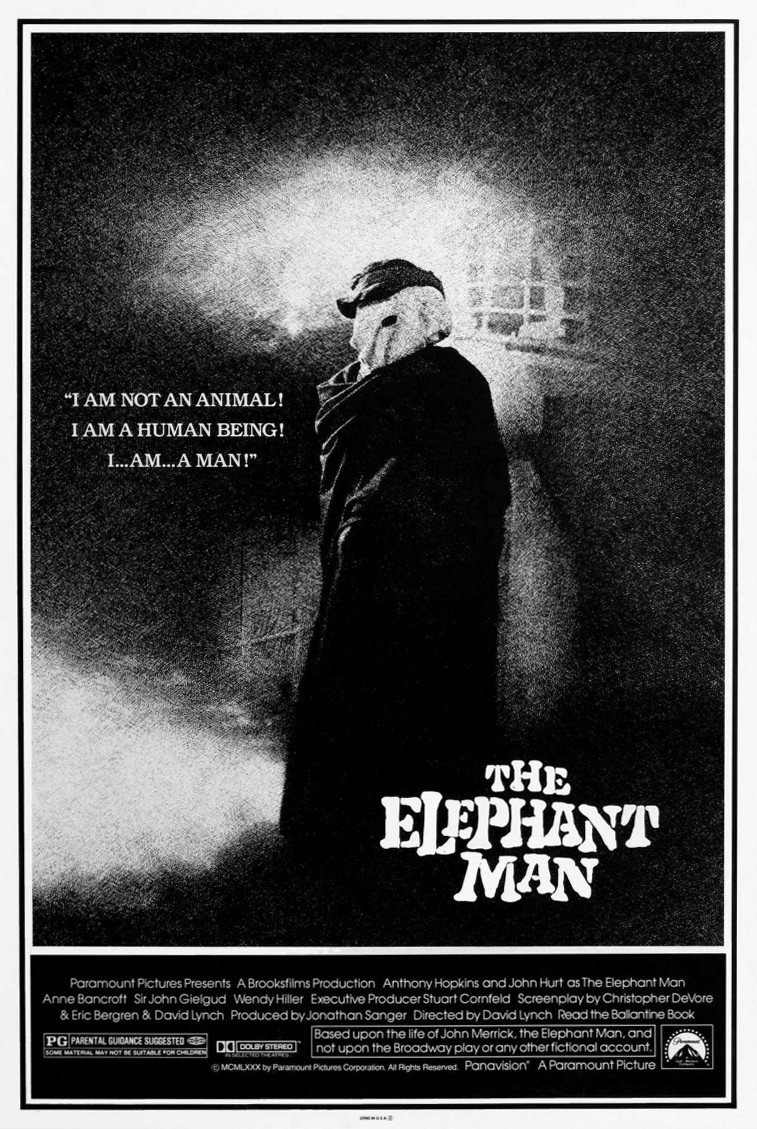
In Victorian London, a surgeon named Frederick Treves pays to examine John Merrick, a severely deformed man displayed in a traveling freak show. Treves assumes Merrick cannot speak or think. He is wrong. As the two men spend more time together, a friendship develops, and Merrick is revealed as a person of profound intelligence, sensitivity, and dignity. A biographical drama about what it means to see another human being clearly. The film is shot in black and white by David Lynch.
The Elephant Man is a 1980 biographical drama directed by David Lynch and written by Lynch, Christopher De Vore, and Eric Bergren. The film is loosely based on two source texts: The Elephant Man and Other Reminiscences (1923) by surgeon Frederick Treves and The Elephant Man: A Study in Human Dignity (1971) by Ashley Montagu. John Hurt plays John Merrick, a severely deformed man living in Victorian London, and Anthony Hopkins plays Dr. Frederick Treves, the surgeon who rescues him from a freak show and arranges for him to live at the London Hospital. The supporting cast includes Anne Bancroft, John Gielgud, Wendy Hiller, Freddie Jones, and Michael Elphick. Cinematography is by Freddie Francis, with a score by John Morris. The film was executive-produced by Mel Brooks, uncredited, to avoid audiences associating it with his comedic work.The film was nominated for eight Academy Awards, including Best Picture, Best Director, Best Actor for Hurt, and Best Adapted Screenplay, and won three BAFTA Awards, including Best Film and Best Actor. It also won the César Award for Best Foreign Film. The film was a significant commercial success, grossing $26 million domestically against a $5 million budget. It is part of the Criterion Collection (spine #159) and has been preserved in the United States National Film Registry. Core themes include human dignity, compassion, cruelty, celebrity, and the gap between appearance and inner life. The film is widely regarded as one of the defining films of Lynch's career and of 1980s cinema.