
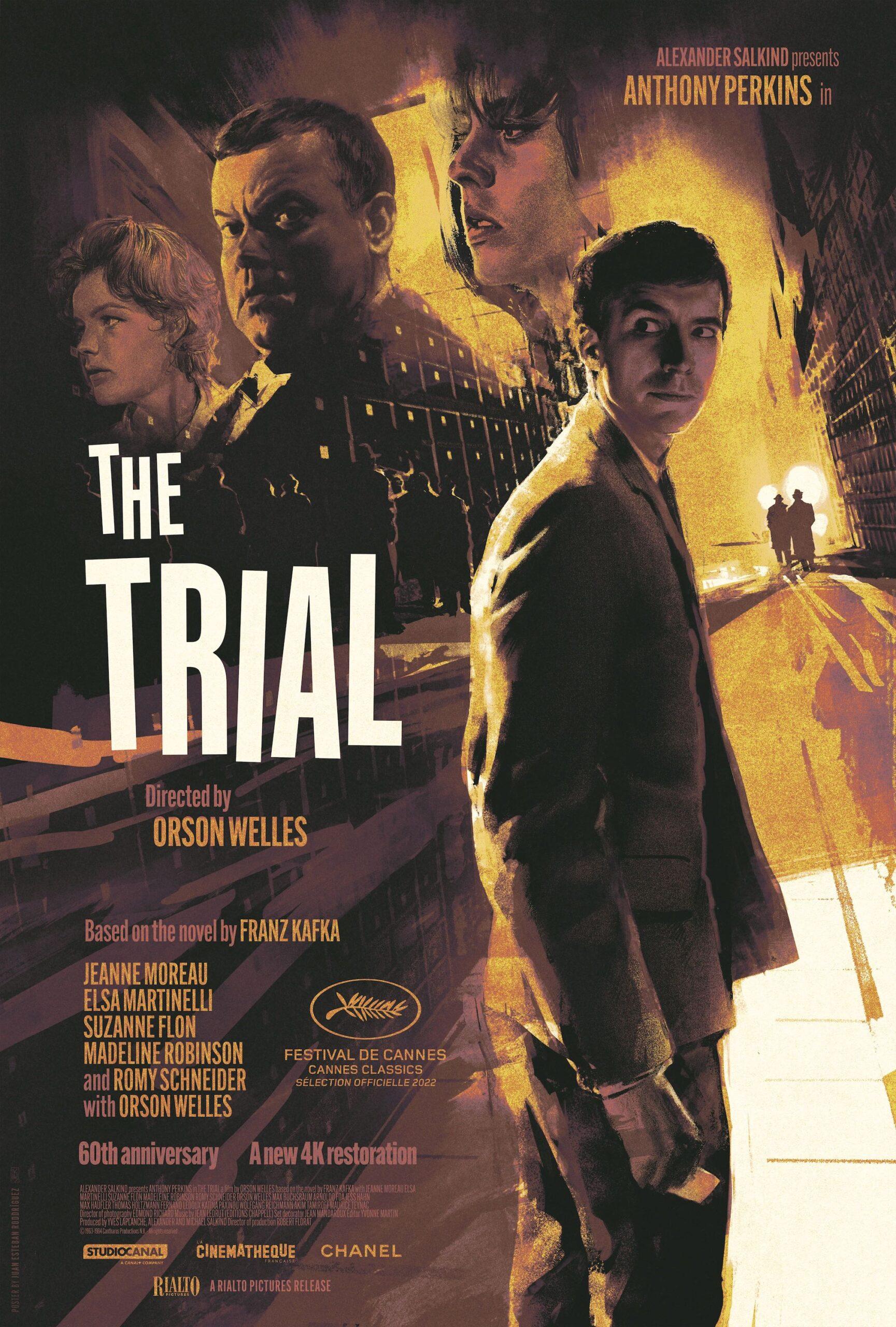
The Trial
Rialto Pictures Dec 22, 1962


An unassuming office worker is arrested and stands trial, but he is never made aware of his charges.
Note:
Releases
Original Release | Dec 22, 1962
View Advanced Data
Current Showtimes
orround
- Fri Jun 5
- Sat Jun 6
- Sun Jun 7
- Mon Jun 8
- Tue Jun 9
- Wed Jun 10
- Thu Jun 11
Director & Top Cast
Technical Specifications
Aspect Ratio: 1.66 : 1
Other Details
Country of Origin: France, Italy, West Germany
Language: English
Summaries
Plot Summary
- A movie that deals with the subject of judicial system in abstract symbolism. A man is charged with a crime that he is told nothing about. He is forced to deal with people who tell him nothing of value while expecting him to feel guilty about something he does not know he has done. The movie is a satirical view of the justice system in America where the Police, Judge & advocate are the gods & the accused has no rights, no voice & whose opinion counts for nothing.Josef K. (Anthony Perkins) is sleeping in his bedroom, in an apartment he shares with other lodgers. He is awakened when a man in a suit opens his bedroom door. Josef assumes the glib man is a policeman, but the intruder does not identify himself and ignores Josef's demand to produce police ID. Several detectives enter and tell Josef he is under open arrest. In another room Josef K. sees three co-workers from his place of employment; they are there to provide evidence regarding some unstated crime. The police refuse to inform Josef K. of his misdeeds, or if he is even being charged with a crime, and they do not take him into custody. They question everything, the choice of clothes, the choice of music, the 4 holes in his room hidden by a carpet (It was a dentist's office, and the holes were used to screw down the dentist's chair). The officers want a bribe, but don't want to ask for it. The first detective refuses to return Josef's ID to him and says that his actions and refusal to cooperate is attracting attention. There is no charge, and the Inspector refuses to make any.After the detectives leave, Josef converses with his landlady, Mrs. Grubach (Madeleine Robinson), and neighbor, Miss Marika Burstner (Jeanne Moreau), about the strange visit. Burstner works night shifts at a dance bar and Grubach doesn't like that. She says she gave the room to Burstner as she came with her mother, all respectable. But then the mother died, and the late-night shifts started. Josef has feelings for Burstner, but she is always tired and afraid of Grubach finding an excuse to throw her out of the building. Burstner invites Josef to her room and gets talking but gets increasingly agitated to learned that he is being interrogated by the police and throws him out.Later he goes to his office, where his supervisor thinks he has been having improper relations with his teenage female cousin Irmie (Naydra Shore) (who had come to visit him very suddenly at his office). Josef brings back a cake for Burstner, only to find an old woman dragging a heavy suitcase belonging to Burstner out of their building. Josef gets no answers about whether Burstner left because Josef tried to kiss her or if Grubach asked her to leave. That evening, Josef attends the opera but is abducted from the theater by a police Inspector A (Arnoldo Foà) and brought to a courtroom, where he attempts in vain to confront the still-unstated case against him.Josef returns to his office and discovers the two police officers who first visited him being whipped in a small room (Due to Josef's complaint that they demanded a bribe from him). Josef's uncle Max (Max Haufler) suggests that Josef consult with Albert Hastler, The Advocate (Orson Welles). Josef and Max pass via the computer room, a device which is known to provide answers when given facts. But even the computer cannot tell what the charge against Josef is.After brief encounters with the wife of a courtroom guard Hilda (Elsa Martinelli) and a roomful of condemned men awaiting trial, Josef is granted an interview with Hastler, which proves unsatisfactory. Hastler already knows about Josef's case. He was visited by Chief Clerk of the Law Court (Fernand Ledoux). They discuss the relevance of the first pleas in criminal cases.Hastler's mistress Leni (Romy Schneider) (she wants Josef to make love to her, but Josef refuses since he loves Burstner. They get playful over a bed of law papers & books. Leni tells Josef that he is a troublemaker. She advises him to confess) gives him a key, so he can return anytime he wants. Josef returns to the court and meets Hilda. Hilda tries to seduce Josef. She tells Josef that the Examining Magistrate (Max Buchsbaum) wrote a long report about Josef and is hitting on her. Bert the law student (Thomas Holtzmann) comes in and reveals that he is spying on Hilda for the Examining Magistrate. Bert carries Hilda to the Magistrate. Josef meets Courtroom Guard (Wolfgang Reichmann), Hilda's husband. He knows how the Examining Magistrate has been abusing Hilda sexually. But he can't do anything as his job depends on his cooperation in the matter. Josef comes across hundreds and hundreds of accused waiting for their chance at justice. He feels suffocated and wants to find his way out.Josef decides to fire Hastler as he is not doing anything except delaying the trial. Josef goes back to and finds that she has been sleeping with Bloch (Akim Tamiroff), one of Hastler's clients. Bloch tells Josef that he has 5 other advocates working for him and that Hastler is one of the lower advocates in the court. Bloch sleeps in Hastler's house since his case has been going on for yrs and now Bloch is very dependent on Hastler and if he misses his meeting then Hastler makes him wait much longer for the next one. Josef meets Hastler and announces his intention to dismiss him. Hastler summons Bloch and shows Josef just how much power he has over his clients. He hurls abuses at Bloch, and he does nothing more than apologize to him. Leni suggests that Josef seek the advice of the artist Titorelli (William Chappell) who draws portraits of all judges and court officials, but this also proves unhelpful, as even he does not have the kind of influence to get Josef acquitted. Seeking refuge in a cathedral, Josef learns from a priest (Michael Lonsdale) that he has been condemned to death. Hastler abruptly appears at the cathedral to confirm the priest's assertion.On the evening before his thirty-first birthday, Josef is apprehended by two executioners and brought to a quarry pit, where he is forced to remove some of his clothing. The executioners pass a knife back and forth, apparently deliberating on who will do the deed, before handing the knife to the condemned man, who refuses to commit suicide. The executioners leave Josef in the quarry and toss dynamite in the pit. Josef laughs at his executioners and picks up the dynamite. From a distance one can hear an explosion and smoke billows into the air.
Storyline
- Josef K wakes up in the morning and finds the police in his room. They tell him that he is on trial but nobody tells him what he is accused of. In order to find out about the reason of this accusation and to protest his innocence, he tries to look behind the facade of the judicial system. But since this remains fruitless, there seems to be no chance for him to escape from this Kafkaesque nightmare. — Joern Richts